

By the time Ray and I cross the Kentucky line on the drive south, my lower back usually has a vote in how the rest of the day goes. Thirty-one years bent over a dental chair left me with a stubborn ache that wakes up around hour three of any long sit. The ache is not sharp and it is not new. It is just there, a low thrum of complaint that gets louder the longer I sit. The SUV seat that felt fine in the driveway feels like a park bench by the time we reach the Florida line, and I used to arrive at the condo stiff, cranky, and useless for the rest of the evening. I have tried a rolled-up beach towel, a stadium seat cushion, and one very expensive gel pad that slid sideways on the first curve. The thing that actually changed the drive was a lumbar pillow from Everlasting Comfort, and the way I use it matters as much as the pillow itself.
This is the routine that works for me, learned over two winters of two-day trips between western Michigan and the Gulf coast of Florida. It is not medical advice. It is what a retired hygienist with a cranky back does so she can arrive at the condo and unpack the car instead of lying down for an hour first. If your pain is new, sharp, spreading, or comes with numbness, talk to your doctor or physical therapist before you change anything about how you drive.
The pillow that finally stayed put on the drive south
The Everlasting Comfort lumbar pillow is the one back support that has survived two round trips in our SUV. It straps to the seat, weighs about a pound and a half, and moves from the car to the camper to the couch without a fuss. That is why it is the first thing I pack for the trip.
Amazon Check Today's Price on Amazon →How I Set Up the Drive
The pillow does not work by magic. It works because of where I put it, how I strap it, and how I set the seat around it. The whole setup takes about five minutes at home before we load the suitcases, and it saves me from spending the first day of vacation recovering from the second day of driving. Here are the five steps I use every time.
Step 1: Put the pillow where your back actually curves
The most common mistake I made with back pillows was placing them too high. A lumbar pillow is not a headrest. It belongs in the small of your back, the spot that arches when you stand up straight, not up between your shoulder blades. The Everlasting Comfort pillow measures about 13 inches across and 12.6 inches tall, and nearly all of that height is meant to sit against your lower spine. The top edge should land around the bottom of your rib cage, not at your shoulders. The first time I used it, I had it too high and spent a hundred miles wondering what everyone saw in lumbar pillows. Then I moved it down two inches and understood.
Sit in the seat first, then tuck the pillow behind you. If you put the pillow on the seat and then sit on it, you will end up on top of the foam instead of against it, and the support will be aimed at your tailbone instead of your lower back. I lean forward just enough to slide the pillow in, settle back, and let my lower back meet the foam before my shoulders touch the seat. That order matters more than any adjustment I make later.
The high-density memory foam is firm enough to hold its shape under you without feeling like a brick. It is compressible, which is the part that matters on a long drive: it gives a little when you shift, then springs back when you straighten up. The cover is breathable and removable, which I appreciate by hour six, when the car is warm and my back is doing all the work. If the pillow ever needs a wash, the cover comes off and goes in with the laundry.
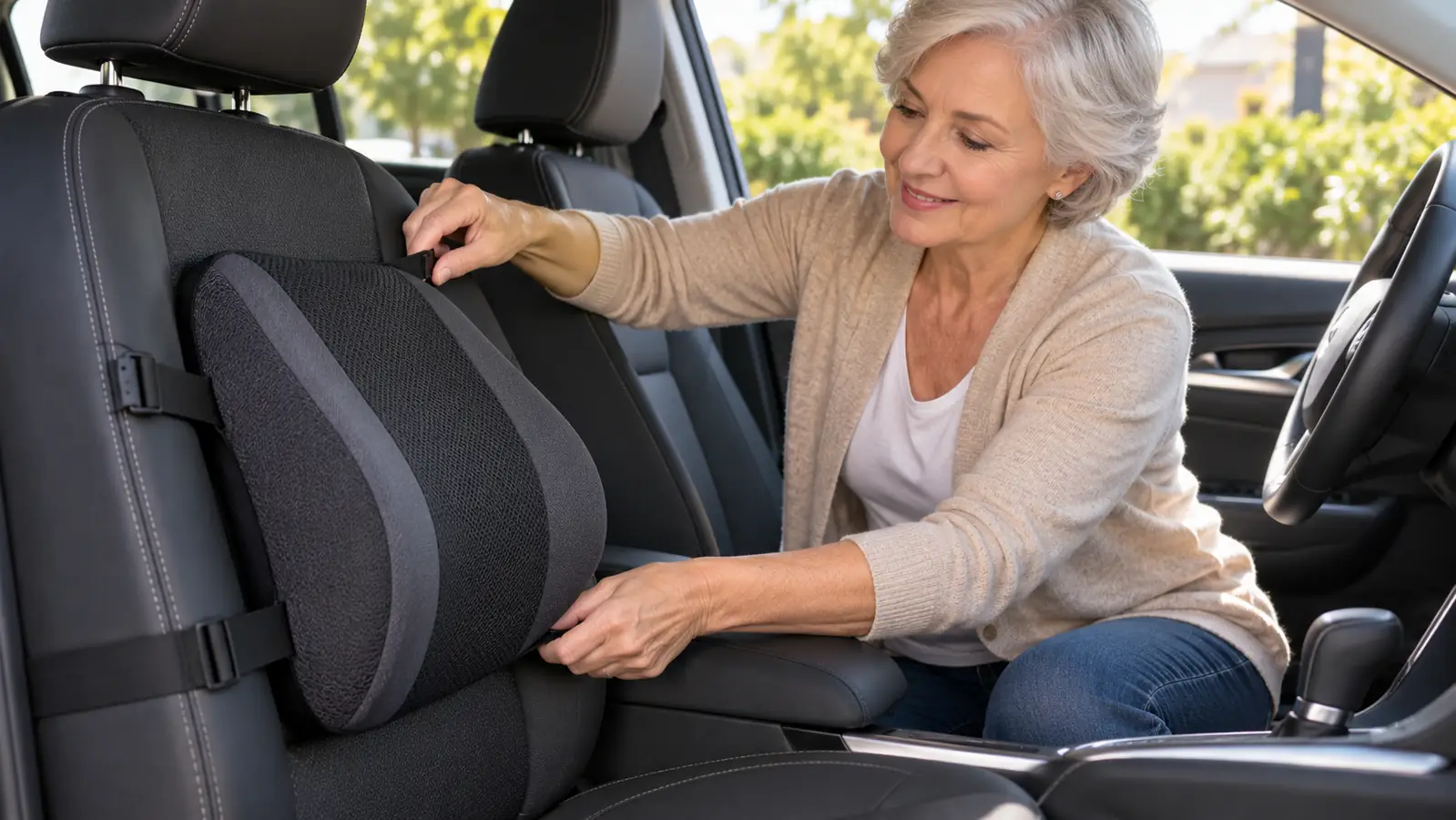
Step 2: Strap it to the seat so it does not wander
My gel pad slid. Every curve, every brake, it crept sideways until I was twisted against the door, which made my back worse than no pillow at all. The Everlasting Comfort pillow solves that with dual adjustable straps that wrap around the seatback, plus extension pieces for seats with posts that sit farther apart. It takes about thirty seconds to secure, and it stays where you put it for the whole two-day trip.
Run the straps around the seatback at about the height of the pillow's middle, pull them snug, and tuck the loose ends out of the way. If you move the pillow between cars, the straps make it a two-minute job instead of a project. Our SUV has one seat with a fixed headrest and one with posts, and the extensions handle both. I have also used the pillow on the couch and in the camper dinette, where the straps wrap around the cushion just as easily.
The pillow weighs about a pound and a half, so it is not going to crush anyone in the back seat if it gets tossed there between trips. It is also latex free, which matters to me because I react to latex in some elastic and foam products. I did not expect to care about that, and then I did. Small details like that are why this pillow has stayed in the car while the gel pad went to a garage sale.
Step 3: Set your seat up to work with the pillow, not against it
A lumbar pillow can only do so much if the seat itself is working against you. Before we leave, Ray adjusts my seat so my hips sit slightly higher than my knees, which takes pressure off the lower back. I sit close enough to reach the pedals without stretching, and I angle the seatback just past upright so the pillow has a flat surface to press against. These three adjustments take a minute and they make the pillow twice as effective.
If the seatback is reclined too far, you end up slouching into the pillow instead of being supported by it. If it is too upright, you fight the pillow all day. The right setting is the one where you can relax your shoulders and still feel the foam against the small of your back. I find it by sitting all the way back, letting my shoulders drop, and then adjusting the seatback until the pillow and my spine agree.
In the winter months, I turn the seat heater on low for the first hour. Warmth loosens my back muscles, and the pillow holds me in a better position while it works. The pillow is not heated, so I bring the warmth myself. If your car does not have seat heaters, a hot water bottle against the lower back for the first hour does the same job. The point is to start the drive with a relaxed back, not a cold, tight one.

Step 4: Take the breaks your back is asking for
The pillow makes the sitting part bearable. It does not replace getting out of the car. My physical therapist gave me a simple rule: every two hours, get out and walk for five minutes, even if it is just to the next rest stop and back. On our last trip south, we stopped at a rest area with a walking path and did two laps. My back thanked me for the next hundred miles. It is tempting to skip the stops and make better time, and I have done that exactly once. I do not recommend it.
When you stop, do not just stand there. Walk. Swing your arms. Let your hips open up. If you have a small dog with you, this is the perfect time to let them stretch their legs too. Biscuit and Pepper have learned that rest stops mean a walk, and they remind us before we even park. A five-minute walk for them is a five-minute reset for my back, so everybody wins.
If you cannot stop, at least shift your position in the seat. Tuck the pillow out from behind you for ten minutes and let your back rest flat, then put it back. The compressible foam makes it easy to pull out and reposition one-handed while Ray drives. Small movements every hour beat one big stretch at the end of the day. I learned that the hard way on a trip where we pushed through and I paid for it that night.
Step 5: Move it with you, so the good posture does not end at the car door
The reason the Everlasting Comfort pillow lives in the car full time is that the drive is not the only place my back complains. It complains in the camper's dinette booth, on the condo's firm couch, and on the golf cart seat when we take the dogs to the beach. The pillow is portable by design, and moving it from the SUV to the camper takes about as long as it takes to say the word portable.
In the camper, I tuck it behind my back in the dinette and suddenly the booth seat is tolerable. At the condo, it lives on the couch for evening TV. The removable cover means I can wash it when the dogs have been on the furniture, which is more often than I would like to admit. It is the rare piece of back gear that earns a spot in more than one room instead of living in a closet.
The last thing I do before we leave Florida in the spring is take the pillow off the condo couch and put it back in the SUV for the ride north. It has made the trip in both directions for two winters now. The straps still hold, the foam still springs back, and the cover still comes off for the wash. That is the part that surprised me most: it has not worn out, and my back has not stopped appreciating it.
What Else Helps
A pillow is a tool, not a cure. What actually keeps my back happy on long drives is the combination: the lumbar pillow for support, the two-hour walk breaks, and the stretches my physical therapist gave me. I do a standing hamstring stretch and a seated twist at every fuel stop, and I do them again in the hotel room before bed on the first night of the trip. Fifteen minutes total, and it makes the second day of driving noticeably easier.
If you are setting up for a long drive and your back already hurts, start with the basics before you buy anything. Adjust the seat, take the breaks, and see a physical therapist if the ache is new or getting worse. Pain that is sharp, spreading, or comes with numbness is worth a call to your doctor before you spend any money on cushions. The pillow helped me, and it may help you, but it is not a reason to skip professional advice.
One more thing: give the pillow a fair chance. The first day with any new back support feels strange because your back has spent years slouching in its own way. I almost gave up on this pillow after one trip. I am glad I did not, because the second trip is when my back started to relax into it. The same will probably be true for you, so try it for a full drive before you decide.
By hour six of the drive south, my back was still quiet. That had never happened before.
Set up your seat before the next trip
If your lower back votes against you around hour three of a long drive, the Everlasting Comfort lumbar pillow is the one support that has stayed put in our SUV for two winters of round trips. It straps on in seconds, moves between the car and the couch, and the company backs it with a lifetime replacement guarantee.
Amazon Check Today's Price on Amazon →