
Somewhere around year twenty of leaning over a dental chair, my lower back started keeping a calendar of its own. It ached after long drives, after a morning of weeding, and on the nights I slept on a mattress that was past its prime. By the time I retired at sixty-two, I had tried a heating pad, a lumbar roll, a foam roller, and a few stretches my physical therapist gave me. The heating pad felt good while it was on and did nothing once it was off. The foam roller helped, but I had to be in the mood to work at it. The ProsourceFit Acupressure Mat and Pillow Set is the first thing that makes me want to lie down and do nothing for a while, and still leaves my back quieter afterward.
I want to be clear about what this is not. It is not a machine. It does not plug in, vibrate, heat up, or massage you. You lie on it, the little plastic points press into your back, and for the first few minutes it feels like exactly what it is: a bed of small bumps. Then something shifts. Your muscles stop arguing. Your breathing slows. By the time ten minutes are up, you are usually not in a hurry to move. That has been my experience just about every evening for the past six weeks.
The Quick Verdict
A simple, portable acupressure mat and pillow set that has become part of my evening routine. It will not fix a serious back condition, but for everyday achiness it earns its spot by the couch.
Amazon Check Today's Price →A Back Tool That Needs No Power, No App, and No Effort
The ProsourceFit Acupressure Mat and Pillow Set is the rare recovery tool that works while you do nothing. Lay it on the floor, lie down, and let the points do the talking.
Amazon Check Today's Price on Amazon →How I've Used It
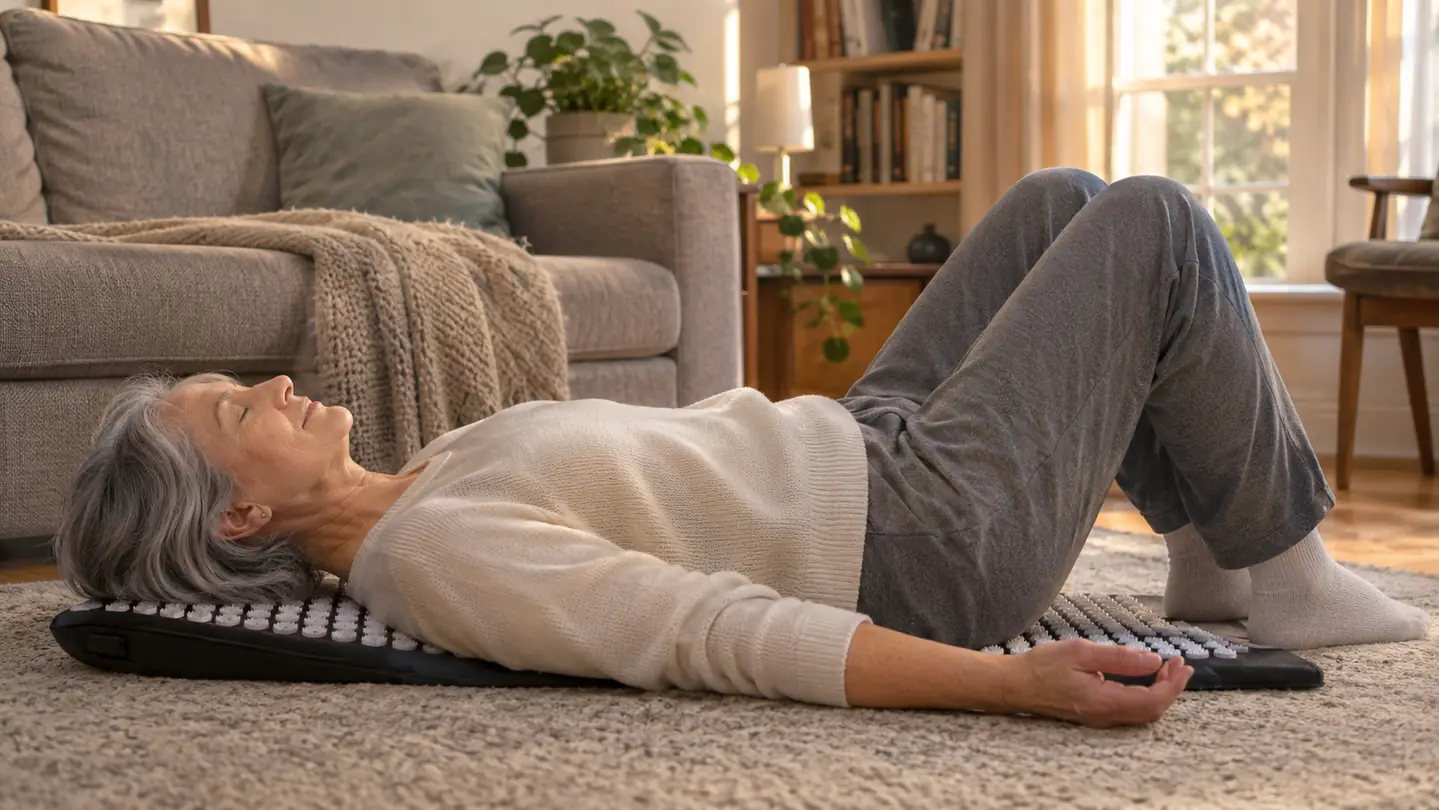
Most nights I use it in the living room around nine o'clock, after the dishes are done and Ray has settled into his chair. I lay the mat on the carpet, put the pillow at the top, and lie down on my back with my knees bent. The first time, I lasted four minutes. Now I set a kitchen timer for fifteen and usually stay a little longer.
We have two small rescue dogs, Biscuit and Pepper, and they have learned that mat time is not lap time. Biscuit will sit a few feet away and watch. Pepper tries to sniff the spikes once, remembers, and curls up on the couch. It has become the quietest part of my day, which is not something I expected from a mat with bumps on it.
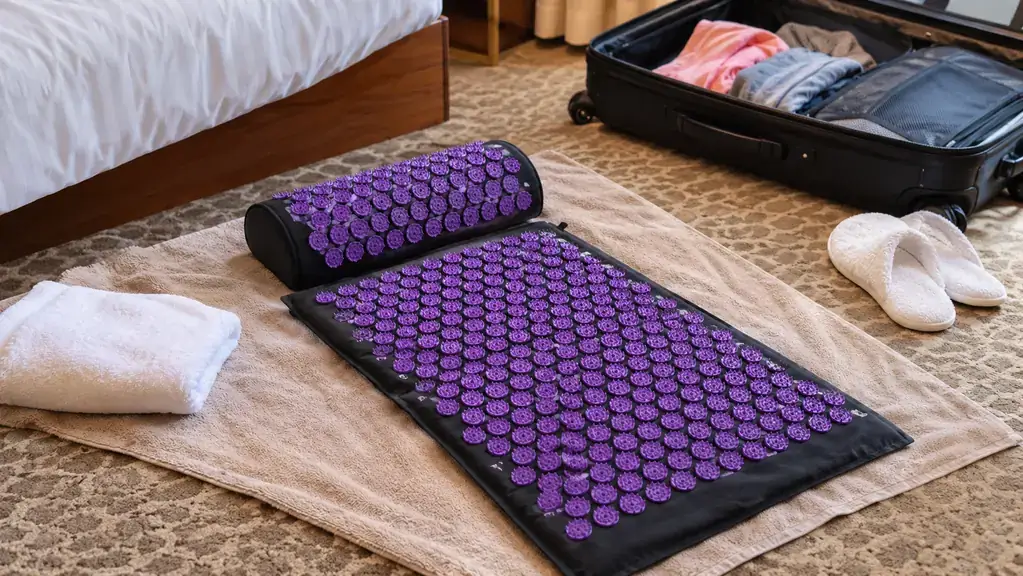
On travel days I use it differently. After a long stretch in the passenger seat of our mid-size SUV, my back is usually the first thing to complain. When we stop for the night, I take the mat and pillow out of the suitcase, lie on the hotel carpet for ten minutes, and get up noticeably looser. I used to dread that first hour after we got out of the car. Now I look forward to it. The whole set weighs about a pound and a half, and it packs down small enough that I do not have to think about whether it earns its space.
Ray has tried it twice. He is sixty-four, retired, and mostly drives on the trip south, so his back complains about different things than mine. He lasted six minutes the first time and said it felt like lying on a bin of plastic bricks. The second time he made it to ten and admitted his shoulders felt looser. I do not think he will ever be as devoted as I am, but the fact that he tried it twice tells you the mat is not hard to live with.
What the Set Actually Is
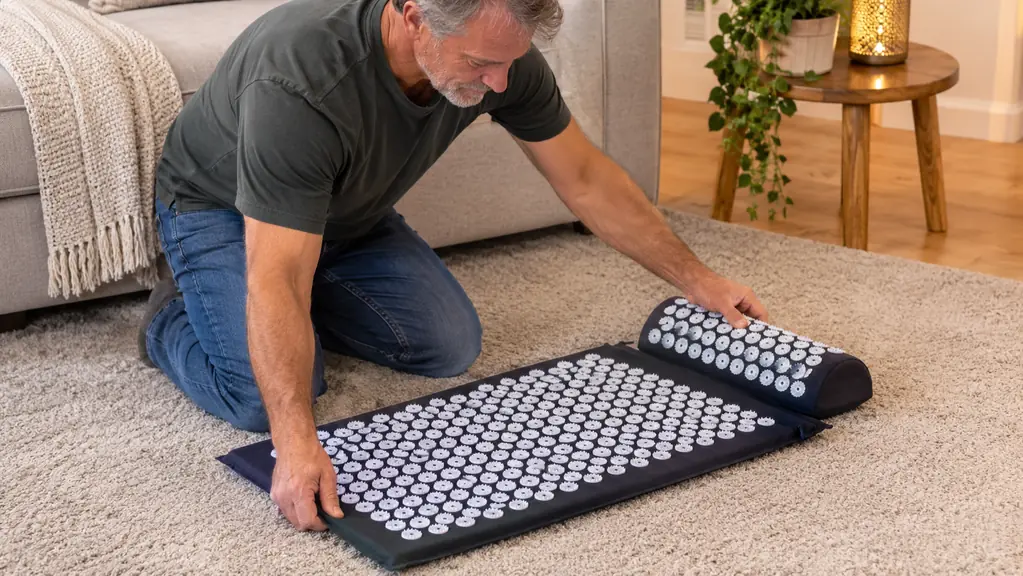
Inside the box you get two pieces: the mat and a smaller pillow. The outside of both is 100 percent cotton. The inside is foam. The pointed parts are ABS plastic, which is the same hard plastic used in a lot of household products. Nothing about it is sharp enough to break skin. It is not a bed of nails in the scary sense. It is a grid of points that press into your muscles while your body weight does the work.
The idea is simple. You lie on the points for ten to thirty minutes a day. The pressure stimulates the same kinds of nerve endings that a massage therapist works on, and your muscles gradually let go. The manufacturer lists pain relief, stress relief, and fatigue relief as the benefits, and after six weeks I would say all three are real, in that order.
There is no power source at all. No cord, no batteries, no remote, no app, no timer, no heat. That is the whole point. Manual means you are the motor. You just have to show up and lie there. For someone like me, who has a drawer full of gadgets that need charging, that simplicity is the feature.
Here is the routine that worked for me. I clear a spot on the carpet, lay the mat flat, and put the pillow at the top. I lie down slowly, because dropping onto the points is a mistake. Then I breathe. That sounds too simple to be worth writing, but it is the whole method. The more I tried to relax, the faster my back stopped complaining. The nights I rushed it were the nights it took longer to settle.
What Six Weeks of Evenings Taught Me
The first three sessions were not comfortable. I want to be honest about that because most reviews skip it. The points feel intense on a back that is not used to them. My lower back, in particular, complained for the first few minutes each time. I almost quit on night two. What kept me going was that the discomfort faded by the fifth minute, and the hour after the mat was noticeably better than the hour before it.
By the second week, my body stopped treating the points like an invasion. I started to look forward to it. By week three, I noticed that the ache I usually felt when I first stood up from the couch was not there on mat nights. That is not a scientific study. It is one woman's back, and backs are stubborn and personal. But the pattern has held for six weeks, and I am a person who needs a pattern to keep doing a thing.
The other thing I noticed is that it works on the neck too. The pillow is small enough to tuck under the curve of my neck while I lie on the mat, and it targets the same kind of tension I used to carry after a day of hygiene work. I do not use it every night, but on nights when my neck is tight, it is the piece that makes the set feel complete.
I have also learned that ten minutes is enough on a bad day. My instinct on a high-pain day is to do more, but with this mat, more is not better. Ten minutes gets the worst of the ache out. Thirty minutes is a luxury for evenings when I am already relaxed. There have been nights when I set the kitchen timer for ten, and nights when the timer goes off and I stay for the full thirty because it feels that good.
The change did not happen all at once, and I do not want to oversell it. I still have mornings when my back reminds me I spent thirty-one years bent over a patient chair. What changed is the baseline. The constant low-grade ache that used to be there by early afternoon is quieter now. Some of that is the mat. Some of it is that I am retired and sleeping better. But the mat is the only thing I added, and the timing lined up.
The Part Nobody Warns You About
First, the first minute is the hardest minute. Your brain sees a surface covered in bumps and wants to argue. Give it five minutes before you decide. Almost everyone I have handed the mat to has said the same thing: it is intense at first, then it gets quiet.
Second, it is not a treatment for a serious condition. If your back pain is new, sharp, spreading, or comes with numbness, this is not the tool to start with. That is a conversation for your doctor or physical therapist. I say that because I have a long-standing achy back, not a medical one, and I have seen a physical therapist for mine. This mat is for the everyday kind of ache that builds up from sitting, driving, gardening, and sleeping on a mattress that has seen better days.
Third, it is not water resistant. I keep mine on carpet or a towel, never on damp grass or a pool deck. It is also a home-grade product, which means it is built for calm evenings, not for heavy clinical use. Treat it gently and it should last, but it is not built like a piece of gym equipment.
One more honest note: the first week is the week that decides whether you will keep using it. I almost quit on night two because my back was not used to the pressure. By night five, the same pressure felt like a release. If you try it and the first session is too much, do not judge the mat on that one session. Give it four or five short sessions before you make up your mind. That advice came from my physical therapist, and it turned out to be right.
How It Fits Into Our Snowbird Life
We are snowbirds. Summers in western Michigan, winters on the Gulf coast of Florida, and a two-day drive between them every year. That drive used to be the part I dreaded most for my back. Now the ProsourceFit mat and pillow come along in the suitcase, and the first thing I do when we check into the condo is find a patch of carpet for them.
It has also earned a place in the camper. We take a small travel camper out for a week or two in the summer, and space is precious. The set is about seventeen inches long and weighs a pound and a half, so it tucks into a gap that would otherwise hold a pair of shoes. When I wake up stiff from a camper bed, ten minutes on the mat before coffee changes the whole day.
I will not pretend it replaces a good night's sleep or a proper stretch routine. It does not. But it has replaced the heating pad in our house, because the heating pad only worked while it was on. The mat keeps working after you get up. That is the difference I feel.
The condo we rent in Florida has tile floors in the kitchen and a thin carpet in the living room. Thin carpet is enough. I lay a bath towel down anyway, mostly because it makes the mat feel more like a deliberate part of the evening and less like something I tripped over. Ten minutes on the towel, a glass of water nearby, and the day unwinds. That has become one of my favorite parts of being back in Florida.
What I Liked
- No power, no batteries, no app, nothing to charge
- Cotton exterior and foam interior feel soft against the skin
- Portable enough for a suitcase or camper at 1.5 pounds
- Pillow extends the same pressure to the neck
- Daily 10 to 30 minute sessions genuinely ease everyday lower back achiness
- Simple enough to use while watching TV or listening to a podcast
Where It Falls Short
- First few sessions are intense and take getting used to
- Not a treatment for serious or new back pain
- Not water resistant, so indoor use only
- Manual means you have to make yourself lie down; it will not do the work for you
- Home-grade build, not a heavy-duty clinical tool
I almost quit on night two. By week three, I noticed the ache I usually felt when I stood up from the couch was not there on mat nights.
Who This Is For
This is for the person with the same kind of back I have: not injured, not diagnosed with anything dramatic, just tired from years of leaning, sitting, driving, and sleeping on the wrong mattress. It is for people who want a back tool that does not require motivation. You do not have to stretch, roll, or push. You lie down. If you can lie still for ten minutes, you can use this mat. It is also for people who would rather do nothing than do exercises they will not keep up with.
Who Should Skip It
Skip it if your pain is new, sharp, spreading, or comes with numbness. Skip it if you are looking for something that works while you sleep or sit at a desk, because this is a lie-down-and-be-still tool. And skip it if you cannot tolerate firm pressure on your back for the first few minutes. The intensity fades, but it is real, and you should not have to grit your teeth through something that is supposed to relax you. When in doubt, ask your doctor or physical therapist first. That is not a judgment, just a fit question.
Ten Quiet Minutes, Most Evenings
The ProsourceFit Acupressure Mat and Pillow Set is the rare back tool that works while you do nothing. No cords, no charging, no learning curve. Just a flat spot on the floor and ten to thirty minutes of your evening.
Amazon Check Today's Price on Amazon →