

There is nothing like a bad mattress to make a long-standing back ache feel personal. I am Joan Pressley, and after 31 years of leaning over a dental chair, my lower back lets me know about it every single night if I do not sleep right. Ray and I are snowbirds, so we spend summers in western Michigan and winters on the Gulf coast of Florida. That means we sleep on a lot of different beds: our own at home, a rented condo mattress in Florida, and the occasional camper bunk in between. Some of those mattresses are fine. Some of them are tired, saggy, or just not what my back needs.
You cannot always replace a bad mattress. You can, however, change how you lie on it. The single best change I have made is sleeping with a knee pillow between my legs. The one I kept is the Contour Legacy Leg & Knee Foam Support Pillow for Side Sleepers. It is small, soft, washable, and it does something simple that my back notices right away: it keeps my top leg from dropping forward and twisting my hips. Here is the exact five-step routine I use to sleep comfortably on a mattress that has seen better days.
The one pillow that fixed my side-sleeping position
The Contour Legacy knee pillow keeps your top leg where it belongs, so your hips stay square and your lower back stops taking the blame for a bad mattress. It is the first thing I pack for the drive south.
Amazon Check Today's Price on Amazon →Step 1: Pick the side you actually sleep on
Before you do anything else, figure out which side you naturally fall asleep on. I am a left-side sleeper. Ray is a right-side sleeper. It does not matter which side you choose, but it matters that you know, because everything else in this routine depends on it. If you start the night on one side and wake up on the other, that is fine too. Just set up the pillow on whichever side you start with. I figured mine out the hard way on the first night of our trip south last November. I put the pillow between my knees, fell asleep on my left side, and woke up at 2 a.m. on my right side with the pillow somewhere down by my ankles. The next night I set it up for the side I actually started on, and it stayed where I put it. That sounds like a small thing, but it was the difference between giving up on the whole idea and sticking with it.
The reason side matters is simple. When you lie on your side on a saggy mattress, your top hip wants to roll forward and your top knee wants to drop toward the mattress. That twist travels straight up into your lower back. A knee pillow stops the twist at the source. It gives your top leg something to rest on, which keeps your pelvis from rotating. On a bad mattress, that little bit of support does more for me than any fancy sleep gadget I have tried. Before I found the Contour, I tried a folded bath towel between my knees, then a rolled-up comforter, then a regular bed pillow folded in half. The towel was too thin, the comforter was too hot, and the folded bed pillow slid out by midnight. The Contour is the only one that stayed put and stayed comfortable, which is why it is the one that comes with us.
Step 2: Put the pillow between your knees, not your ankles
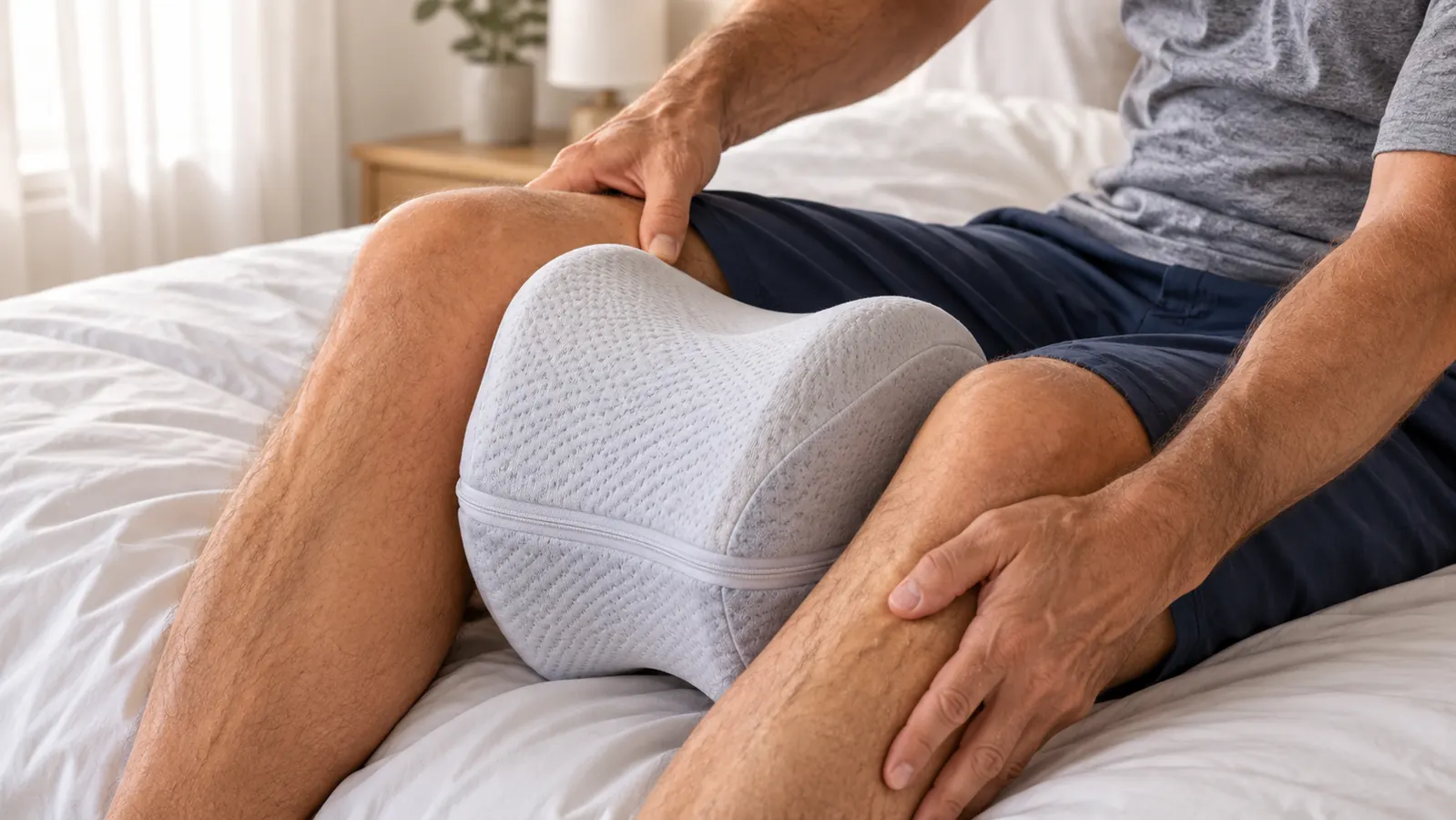
This sounds too basic to matter, but placement is everything. Slide the Contour Legacy pillow between your knees, up near the bottom of your thighs, so your top knee rests on the pillow instead of hovering. If you put it down by your ankles, your knees still touch and your hips still twist. The whole point is to keep your knees stacked and your hips square, and that only happens when the pillow sits where your knees actually are.
The Contour Legacy is a leg and knee foam support pillow, about 10 inches by 9.5 inches, and it is soft, which is exactly what you want here. A firm block pushes your knee too high and throws your hip out of line. This one gives just enough lift. The memory foam fill is wrapped in a soft blend of 62% polyester and 38% lyocell, and the cover is washable, which matters more than you would think once you have used it every night for a few months.
Step 3: Add a little support behind your lower back
Here is where I fixed the part of the problem the knee pillow cannot reach. A sagging mattress dips in the middle, and that dip lets your lower back curve too much. I take a second pillow, roll it loosely, and tuck it into the small of my back. It does not need to be fancy. A rolled-up throw pillow or the spare bed pillow from the closet works. The point is to fill the gap between my back and the mattress so my spine stays in a more neutral line. I fold it longways, tuck the ends under, and it stays put even when I turn over. I have used the same rolled pillow on the camper bunk, where the mattress is barely two inches of foam over plywood, and it helped there too. The roll does not have to be perfect. You are not building a posture clinic, you are just taking the sag out of the mattress where your back meets it.
This is the step that made the biggest difference on the condo mattress in Florida. That mattress has a soft spot right in the middle, and no amount of flipping helped. The first week we were there, I tried sleeping without the back support, just to see. By the third night my lower back was so tight that I dug the spare pillow out of the closet at 10 p.m. and rolled it up. The rolled pillow behind my back, plus the Contour between my knees, turned that saggy mattress into a bed I could sleep through the night on. The next morning I told Ray I felt like myself again, not like someone who had spent the night in a hammock. If you wake up with your lower back feeling tight, try this before you give up on the mattress entirely.

Step 4: Keep your head and neck in line with your spine
A bad mattress makes you toss and turn, and tossing and turning usually means your head ends up at a weird angle. Your regular bed pillow might be too thick or too thin for side sleeping, which puts a kink in your neck that your back feels by morning. I learned this the slow way. For the first two weeks after we got the Contour, I kept my usual thick pillow under my head, and I woke up every morning with a stiff neck on top of my usual back ache. Then I tried sleeping with no pillow at all, and that was worse, because my head dropped down and my neck bent the other way. Finally I swapped in a flatter pillow, one of the older ones from the guest room, and my neck stopped complaining. The flat pillow is the one I pack for the condo now, and the thick one stays home in Michigan. I use that flatter pillow under my head when I sleep on my side, so my neck stays in line with the rest of my spine. If your neck is fine with your usual pillow, leave it alone. The rule is simple: your ear should not be tilted up toward the ceiling or down toward the mattress.
I also make sure the Contour pillow stays put through the night. It is light, only about 198 grams, so it can wander if the sheets are slippery. A quick tuck under the top edge of the blanket keeps it in place. Small thing, but it means I am not fishing around for it at 2 in the morning. On the camper bunk, where the fitted sheet does not fit quite right and everything slides, I tuck the Contour under the corner of the sleeping bag. That has kept it in place through some pretty bumpy nights at the state park.
Step 5: Give the temperature-regulating foam a few nights to do its thing
The Contour Legacy uses temperature-regulating foam that pushes heat outward, away from your body. I did not notice this on the first night, but by the third or fourth night I realized my legs were not getting that sweaty, sticky feeling between my knees that I used to get with a folded blanket. On a warm Florida night, that matters. We had a stretch last February where the condo stayed above 78 degrees even with the ceiling fan on, and the Contour was the only pillow in the bed that did not feel warm to the touch by morning. The foam is soft, so it squishes down a little between my knees, but it is back to its full shape by morning. That is the memory foam doing its job. A pillow that sleeps cool is the difference between staying in a good position and kicking everything off the bed at 3 a.m.
Give yourself a week with this routine before you judge it. The first night, the pillow between your knees will feel like something you have to think about. By night three, it feels normal. By the end of the week, your body starts to expect it. When we pack for the drive south, the Contour goes in the suitcase on top, because I know I will not sleep well in the first motel without it. That two-day drive is hard on my back no matter what, and Ray does most of the driving, so I have learned to make the first motel stop count. I unpack the Contour before I unpack my toiletries. It takes about thirty seconds to set up the whole routine, and it is the difference between arriving in Florida rested enough to enjoy the first morning on the beach and arriving stiff and short-tempered.
What Else Helps
A knee pillow is the center of my routine, but it is not the whole routine. A few other things have earned a place in the camper and the condo. I keep a small flashlight on the nightstand for middle-of-the-night trips, because stumbling around in the dark is how you pull something. I do a few of the stretches my physical therapist gave me before bed, especially the ones for my hips. And I try to get a short walk in during the day, even if it is just down to the beach with our two small rescue dogs, Biscuit and Pepper. Movement during the day makes the mattress less of an enemy at night.
I will also say this plainly: if your back pain is new, sharp, spreading, or comes with numbness, do not take my word for anything. Talk to your doctor or your physical therapist. I am not a medical professional. I am just a retired dental hygienist who spent decades bent over a patient chair and found a combination of small things that helped me sleep better. What worked for me may not work for you, but a knee pillow is cheap to try, easy to pack, and it does not require you to replace the mattress.
The Contour between my knees, plus a rolled pillow behind my back, turned a saggy condo mattress into a bed I could sleep through the night on.
Sleep better tonight, even on a tired mattress
The Contour Legacy Leg & Knee Foam Support Pillow is washable, soft, and small enough to pack for the drive south. It will not fix a broken mattress, but it will fix the way you lie on it.
Amazon Check Today's Price on Amazon →